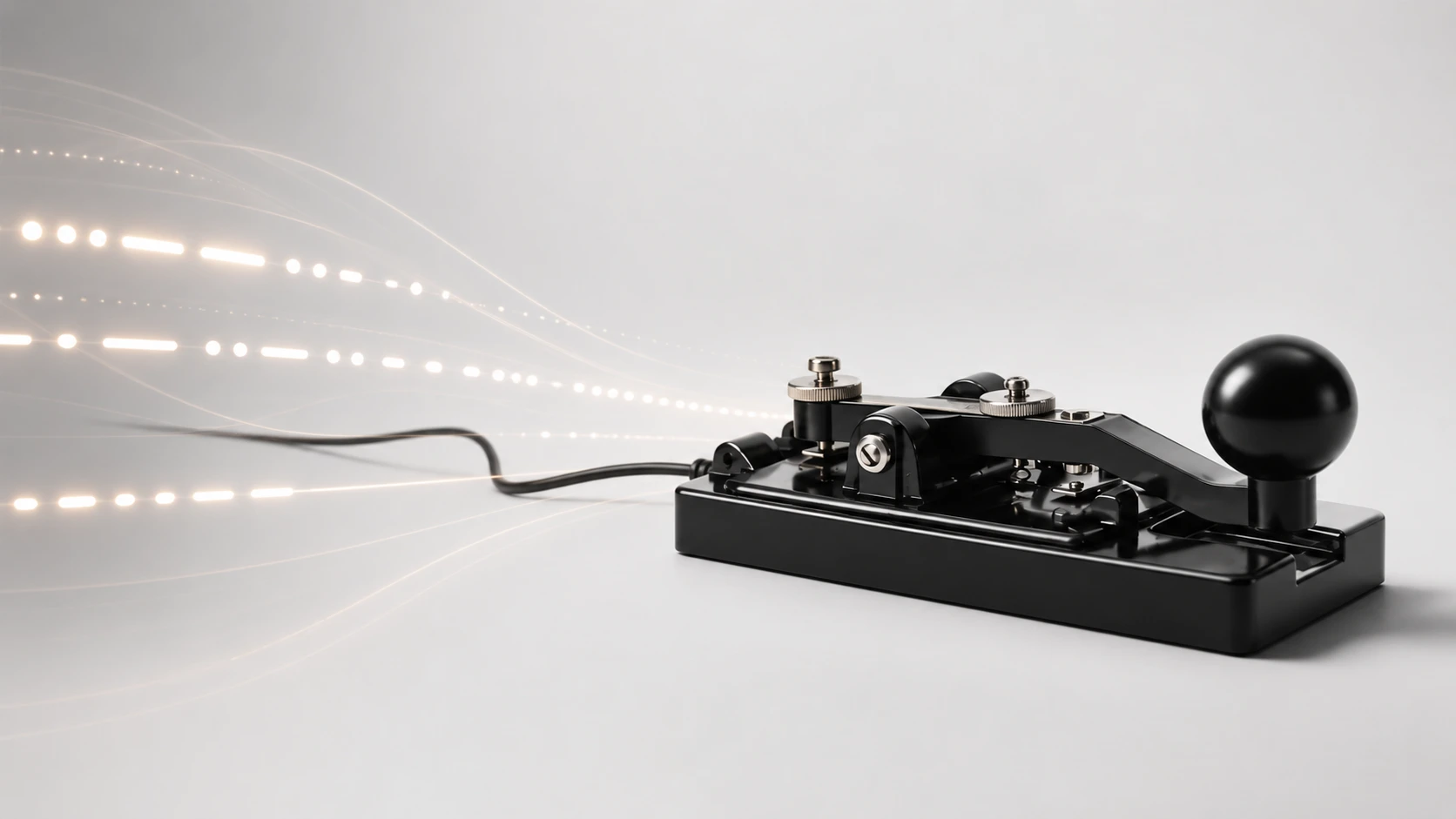
For most of history, messages had bodies. They travelled in saddlebags, ships, pockets, shouted relays, and signal flags. Morse code helped break that old rule. It turned language into timed electrical signals, letting messages move through wire and air instead of waiting for the body that carried them.
More Than Dots and Dashes
Most people know Morse code in the same vague way they know that steam engines mattered or that the Titanic had a radio room. They know SOS, they know there are dots and dashes, and they file the whole thing under old-time communication. That is true as far as it goes, but it undersells the thing badly.
Morse code was not just a quaint signalling method for ships and hobbyists. It was one of the first serious systems that let human language move at the speed of electricity rather than the speed of muscle. Before that shift, messages rode on horses, ships, runners, and line-of-sight signal systems. After it, information could outrun the body that created it. That is a genuine break in history.
It also deserves one important clarification straight away: Morse code is not a cipher. It does not hide meaning. It encodes it. If you know the system, the message is visible or audible immediately. There is no secret key and no concealed transformation in the cryptographic sense. But Morse absolutely belongs on a cryptography site, because it sits right beside the history of secure communication. It was one of the great practical answers to an earlier question: how do you turn language into a form machines can carry?
And the answer, for a remarkable stretch of modern history, was this: with timing.
More Than Marks
Morse code is a method for representing letters, numbers, punctuation, and a few procedural signals as sequences of short and long marks. On paper those become dots and dashes. In real use they might be heard as short and long tones, sent as electrical pulses, flashed as light, or tapped as physical signals.
A few famous examples make the shape of it obvious:
E = .T = -S = ...O = ---
Which gives the most famous Morse pattern of all:
SOS = ... --- ...
Simple enough. But the code is more than a symbol chart. It is a timed language. A dot is not just a dot. It is a short signal of a defined relative length. A dash is not just a longer mark. It is a signal exactly three times as long as a dot. Silence matters too. The gaps inside letters, between letters, and between words are part of the code itself.
That sounds minor until you try to hear or send it properly. Then you realise Morse is not really written language in the usual sense. It is structured rhythm with meaning attached.
The Full Morse Alphabet at a Glance
For an article like this, a full reference table is not optional. Readers expect it, and they are right to.
Letters A-Z
| Letter | Morse | Letter | Morse | Letter | Morse |
|---|---|---|---|---|---|
| A | .- |
J | .--- |
S | ... |
| B | -... |
K | -.- |
T | - |
| C | -.-. |
L | .-.. |
U | ..- |
| D | -.. |
M | -- |
V | ...- |
| E | . |
N | -. |
W | .-- |
| F | ..-. |
O | --- |
X | -..- |
| G | --. |
P | .--. |
Y | -.-- |
| H | .... |
Q | --.- |
Z | --.. |
| I | .. |
R | .-. |
Numbers 0-9
| Number | Morse | Number | Morse |
|---|---|---|---|
| 0 | ----- |
5 | ..... |
| 1 | .---- |
6 | -.... |
| 2 | ..--- |
7 | --... |
| 3 | ...-- |
8 | ---.. |
| 4 | ....- |
9 | ----. |
A few patterns are worth noticing. E and T are the shortest possible letters because common letters were given cheap encodings. S and O form a beautifully memorable contrast. The numbers are even neater: 1 through 5 start with dots, while 6 through 0 start with dashes. There is more structure in Morse than first appears.
A Language Made of Signal and Silence
The deep logic of Morse lies in its timing. International Morse code works with a simple unit system:
- a dot lasts
1unit - a dash lasts
3units - the gap inside one letter lasts
1unit - the gap between letters lasts
3units - the gap between words lasts
7units
That means Morse is partly about marks and partly about absence. The silence is not decorative. It carries the boundaries.
Take the word MORSE:
M = --O = ---R = .-.S = ...E = .
Written plainly:
-- --- .-. ... .
But that notation hides what an operator actually deals with. A trained listener does not sit there translating punctuation marks in their head like a beginner reading off a classroom chart. Good operators hear shape, cadence, and grouping. Morse becomes more like a pattern language than a string of isolated symbols.
That is why old telegraphists and radio operators often talked about receiving Morse "by sound" rather than by mentally counting dots and dashes. At speed, counting is too slow. Recognition takes over.
This is also why Morse can seem oddly musical. The distinction between dit and dah, the spacing between units, and the rhythm of a whole word make it feel closer to percussion than typography.
Why the Code Looks Uneven
At a glance Morse can seem arbitrary. It is not alphabetical. There is no obvious visual elegance to the assignments. Why is Q --.- while E is just .? Why does L get .-..? Why is O three dashes?
Because the code was built for use, not beauty.
One of the smartest principles behind the early code was that common letters should be quicker to send. Alfred Vail is often credited with helping shape this practical side of the system, reportedly estimating letter frequency from the movable type used in a local newspaper print shop. That may sound quaint, but the intuition was excellent. Frequent letters got shorter signals. Rare letters could afford to be more expensive.
That is why E is one dot. It is why T is one dash. Morse is not an exercise in abstract symmetry. It is an attempt to make language more efficient under real operating conditions.
In that sense Morse has a faint family resemblance to later compression ideas. Not the same mathematics, obviously, but the same instinct: frequent things should cost less.
A Worked Example: HELLO WORLD
A concrete example shows how the system behaves.
Let us encode:
HELLO WORLD
Letter by letter:
H = ....E = .L = .-..L = .-..O = ---- word break
W = .--O = ---R = .-.L = .-..D = -..
So the full message becomes:
.... . .-.. .-.. --- / .-- --- .-. .-.. -..
The slash there is a modern text-friendly way of showing a word break. In actual timed transmission, the word boundary would be expressed by a longer gap, not a literal slash character.
Now notice something subtle but important: without proper spacing, Morse becomes much harder to read. If you run all the marks together carelessly, letters blur into each other. Morse only works cleanly because the operator respects the timing discipline.
That, incidentally, is why good operators developed a reputation. Skilled senders had a clear "fist", meaning their personal sending style was clean, legible, and recognisable. Experienced listeners could sometimes identify individuals from the character of their timing alone. That is one of the loveliest human details in old communications history: even in a standardised system, personality leaked through.
From Telegraph Dreams to a World System
The origin story of Morse code is usually simplified into a single heroic inventor. Real history is messier, which is good because messier history is usually more true.
Samuel Morse was an American painter and inventor who became deeply involved in electrical telegraphy in the 1830s. His name became attached both to the telegraph system and to the code, but the code people now think of as "Morse code" was shaped by several hands. Alfred Vail was crucial in developing a practical alphabetic code for telegraph use. Later, Friedrich Clemens Gerke simplified and standardised the system in Europe, and his refinements heavily influenced what became International Morse code.
Some key milestones help keep the chronology straight:
1830s: serious development of electric telegraph systems accelerated in Europe and America1837-1838: Morse and Vail demonstrated their telegraph work and code system1844: the famous messageWhat hath God wroughtwas sent from Washington to Baltimore1848 onward: Gerke's simplified version gained traction in Europe1865: an international standard was established- late nineteenth and early twentieth centuries: Morse spread across telegraph networks, shipping, radio, military communications, and aviation
One detail often missed in the popular story is that the original American Morse code was not identical to the later International Morse code. American Morse had more awkward timing features and some different symbol structures. International Morse was cleaner and better suited to broader use, especially in radio.
So the version that survived was not merely the first version. It was the version refined by operational reality.
The World Before Morse Was Slower Than We Now Remember
It is hard for modern people to feel how radical telegraphy was. We live in a world where messages crossing continents are routine and nearly thoughtless. Before electrical communication, distance was brutal.
A message could go by horse, ship, runner, or carriage. It could also travel visually, using things like semaphore or beacon systems, but those required line of sight and favourable conditions. Night, fog, terrain, and weather could wreck them. They were clever, but limited.
The electric telegraph changed that. Once wires connected two places, messages could move in something close to real time. Morse code was the language that made that possible in practice.
In that sense, Morse did not merely improve communication. It separated communication from transport. That sounds abstract, but it is one of the foundational moves behind the modern world. Once information no longer has to travel at the speed of the messenger, entire systems reorganise:
- finance
- trade
- military command
- journalism
- diplomacy
- shipping
- railways
- emergency response
You can argue about the exact degree, but you cannot sensibly deny the basic fact. The telegraph and Morse helped create the first era of fast networked modernity.
Why Morse Was So Good at Its Job
Morse code lasted for so long because it was brutally practical.
It worked with simple hardware
A key, a sounder, a lamp, a transmitter. You did not need a lushly complex apparatus to use it effectively.
It was human-decodable
A trained operator could hear it, copy it, and react to it directly. No screen required. No printer strictly required. No elaborate interface layer.
It travelled well across different media
Wires, radio, light, sound, touch. Morse was not locked to one transmission channel.
It handled weak and noisy conditions well
This became especially important in radio. A narrow, on-off keyed signal could punch through where voice became muddy and exhausting to understand.
It could be learned to a high level
Skilled operators could send and receive at impressive speeds. Once fluency set in, Morse became less a chart to remember and more a language pattern to hear.
It was flexible under pressure
Distress signalling, field communication, navigation identifiers, routine traffic, message handling, clandestine transmission, visual signalling from ships. Morse could do all of that.
None of this means it was perfect. It means it was effective enough to dominate several serious communication environments for decades.
Radio, Sea Traffic, and the Drama of Real Consequence
Morse's reputation is tied heavily to maritime and radio history, and that makes sense. These were environments where reliable communication mattered and failure could be lethal.
At sea, Morse became central to ship-to-ship and ship-to-shore communication. Distress traffic, safety information, operational messages, and ordinary communications all passed through that world. Later, radio telegraphy extended those capabilities beyond the wire.
The most famous distress pattern of all, SOS, owes part of its success to its simplicity. Three dots, three dashes, three dots. It is striking, balanced, and easy to recognise. People often say it stands for "Save Our Souls" or "Save Our Ship", but those are backronyms. The real point is not the phrase. The point is the signal.
Wireless traffic also produced one of Morse's defining problems: interception. A wired telegraph line could be tapped, but radio made eavesdropping dramatically easier. Anyone in range with the right equipment could listen. That fact shaped military and maritime procedure for decades. Morse remained useful, but it plainly was not secret.
The Titanic sits in this story for obvious reasons. Wireless telegraphy was still comparatively young, crowded, glamorous, and imperfect. Passenger traffic competed with operational concerns. Signals could be missed, mishandled, or delayed. The disaster sharpened awareness of how critical disciplined radio procedure was and helped drive later regulatory changes.
Morse was never just quaint clicking. It lived in systems where mistakes mattered.
War, Espionage, and Why Morse Needed Ciphers
Because this is a cryptography site, the distinction must be made cleanly: Morse code was never secrecy by itself.
If you send plain language in Morse, anyone who knows Morse can read it. Full stop.
That is why operational systems paired Morse with encryption. The Morse layer handled transmission. The cipher layer handled concealment. This division of labour mattered enormously in wartime, intelligence work, and naval signalling.
A resistance operator, for example, might transmit ciphertext as Morse over radio. An enemy intercept station could hear the Morse perfectly well, but if the underlying message was strongly encrypted, the content still remained protected. Or at least that was the hope.
This makes Morse interesting for cryptographic history precisely because it is not a cipher. It sits lower in the stack. It is part of the machinery that lets secret writing travel. Without robust transport and standardised encoding, secure communication is much harder to operate at scale.
That is why Morse belongs in the same conversation even though it is technically a different kind of system.
The Limits of Morse
For all its strengths, Morse had obvious weaknesses.
- It required training. You could not casually improvise fluent Morse. It took practice, timing, familiarity, and sustained use.
- It was labour-intensive. Human operators had to send and copy traffic. That created bottlenecks. Later systems that automated text handling had obvious efficiency advantages.
- It was vulnerable to interception. Especially over radio. The more widely signals propagated, the less any illusion of privacy made sense.
- It depended on human stamina. Fatigue, stress, and sloppy timing degraded performance.
- It did not scale as cleanly as later text systems. Once teleprinters, digital protocols, and more automated communication methods matured, Morse's role shrank.
- It carried language unevenly. International Morse handled the core Latin alphabet neatly enough, but other languages required extensions, adaptations, or separate systems.
In other words, Morse was not displaced because it was useless. It was displaced because newer systems could do more with less human strain.
How Morse Is "Broken", Which Is Slightly the Wrong Question
A classical cipher is broken when someone recovers the hidden message or key. Morse is different because there is no hiddenness built into it.
So asking how Morse is broken is a bit like asking how ordinary printed English is broken. The answer is: it is not. It is simply readable to people who know the system.
Still, there are three ways Morse can fail operationally:
- It can be directly read. Anyone who knows Morse and intercepts the signal can recover the message.
- It can be intercepted in transit. Lines can be tapped. Radio can be monitored. Light signals can be observed.
- It can leak metadata. Even if the message content is encrypted before being sent in Morse, an enemy may still learn useful things from traffic patterns, timing, volume, direction-finding, or operator habits.
That third point matters. In real-world intelligence work, content is only part of the picture. Sometimes who is transmitting, when, from where, and how often matters almost as much as the plaintext itself.
So the honest verdict is this:
Morse is not a secrecy system.
If you need secrecy, add a cipher.
American Morse, International Morse, and Nearby Systems
"Morse code" sounds singular, but historically the picture is broader.
American Morse was the older landline code used in the United States. It had some different symbol structures and timing features and survived in certain railroad and telegraph contexts much longer than casual readers realise.
International Morse was the cleaner, more standardised version that became dominant globally and is the form usually meant today.
Morse also sits among other signalling systems worth knowing about:
- semaphore for visual flag signalling
- heliograph signalling with flashes of reflected light
- Tap Code Cipher in constrained environments
- Baudot and later teleprinter codes as successors in text communication
- procedural signals and prosigns that helped structure message exchange
All of these systems wrestle with the same broad problem: how do you convert human language into operational signals under real-world constraints?
Morse simply happened to become one of the most durable answers.
Why Morse Still Matters
It is easy to call Morse obsolete and move on. That is only partly true.
As a mainstream communication medium, yes, Morse is obsolete. No one serious thinks the world should go back to routine commercial Morse traffic. But as a historical technology, a technical discipline, and a niche practical tool, it is still alive.
It survives in amateur radio
CW remains popular because it is effective, elegant, and still surprisingly useful under weak-signal conditions.
It has persisted in navigation and signalling culture
Aviation and radio navigation used Morse identifiers for a long time, and the legacy remains important.
It still has military and naval niche value
Especially in visual signalling and low-profile communication situations.
It works as assistive technology
This is one of the most humane surviving uses. People with severe motor limitations can sometimes use Morse through blinks, switches, sip-and-puff devices, or other minimal-input systems.
It teaches a durable lesson
Morse reminds us that powerful communication does not require enormous complexity. A binary-feeling signalling system, governed by rhythm and convention, can carry immense consequences.
It also deserves credit as a precursor to the larger digital age. Not because dots and dashes somehow directly became the internet in a simplistic way, but because telegraphy helped normalise the idea that information could be abstracted, encoded, transmitted, received, and decoded through technical systems. Once that conceptual door is open, modern communications history looks a lot less surprising.
A Simple Python Morse Code Translator
Because Morse is an encoding system, it makes an excellent small programming example. The logic is clear, the data structures are simple, and the result is genuinely useful.
The script below can:
- encode ordinary text into Morse
- decode Morse back into text
It uses / as a separator between words.
Python Code
Python exampleShow code
MORSE_MAP = {
    'A': '.-',    'B': '-...',  'C': '-.-.',  'D': '-..',   'E': '.',
    'F': '..-.',  'G': '--.',   'H': '....',  'I': '..',    'J': '.---',
    'K': '-.-',   'L': '.-..',  'M': '--',    'N': '-.',    'O': '---',
    'P': '.--.',  'Q': '--.-',  'R': '.-.',   'S': '...',   'T': '-',
    'U': '..-',   'V': '...-',  'W': '.--',   'X': '-..-',  'Y': '-.--',
    'Z': '--..',

    '0': '-----', '1': '.----', '2': '..---', '3': '...--', '4': '....-',
    '5': '.....', '6': '-....', '7': '--...', '8': '---..', '9': '----.',

    '.': '.-.-.-', ',': '--..--', '?': '..--..', '!': '-.-.--',
    "'": '.----.', '"': '.-..-.', '/': '-..-.',  '(': '-.--.',
    ')': '-.--.-', '&': '.-...',  ':': '---...', ';': '-.-.-.',
    '=': '-...-',  '+': '.-.-.',  '-': '-....-', '_': '..--.-',
    '@': '.--.-.'
}

REVERSE_MORSE_MAP = {value: key for key, value in MORSE_MAP.items()}


def text_to_morse(text: str) -> str:
    """
    Convert ordinary text into Morse code.
    Unsupported characters are ignored.
    Words are separated by ' / '.
    """
    words = text.upper().split()
    morse_words = []

    for word in words:
        encoded_letters = []
        for char in word:
            if char in MORSE_MAP:
                encoded_letters.append(MORSE_MAP[char])
        if encoded_letters:
            morse_words.append(' '.join(encoded_letters))

    return ' / '.join(morse_words)


def morse_to_text(morse: str) -> str:
    """
    Convert Morse code into ordinary text.
    Letters should be separated by spaces and words by '/'.
    Unknown patterns become '?'.
    """
    words = morse.strip().split(' / ')
    decoded_words = []

    for word in words:
        decoded_letters = []
        for symbol in word.split():
            decoded_letters.append(REVERSE_MORSE_MAP.get(symbol, '?'))
        decoded_words.append(''.join(decoded_letters))

    return ' '.join(decoded_words)


if __name__ == "__main__":
    message = "HELLO WORLD"
    encoded = text_to_morse(message)
    decoded = morse_to_text(encoded)

    print("Original:", message)
    print("Encoded: ", encoded)
    print("Decoded: ", decoded)
How the Python Code Works
The logic is pleasingly direct.
1. A dictionary stores the Morse alphabet
MORSE_MAP is just a lookup table from characters to Morse strings.
So:
Hbecomes....Obecomes---5becomes.....
2. A reverse dictionary handles decoding
REVERSE_MORSE_MAP flips the original mapping around so that Morse patterns can be turned back into letters.
That means:
....becomesH---becomesO
3. Encoding splits text into words
Each word is converted letter by letter, then words are joined using / so that the output is readable and unambiguous.
For example:
HELLO WORLD
becomes:
.... . .-.. .-.. --- / .-- --- .-. .-.. -..
4. Decoding reverses the process
The decoder expects spaces between Morse letters and / between words. If a pattern is not found, it returns ? so that bad or unsupported input is visible rather than silently lost.
That is a small design choice, but a good one. Silent failure is irritating in toy tools and disastrous in real systems.
Final Thoughts: The First Great Language of the Electric Age
Morse code now sits in an odd place in cultural memory. It is widely recognised, rarely understood in depth, and too often treated as a charming antique rather than the hard-working infrastructure language it once was.
That is a mistake.
Morse helped make modern communication thinkable. It taught the world that language could be abstracted into signal, pushed across distance, and reconstructed elsewhere with astonishing speed. It was not itself a cipher, but it stood beside ciphers and often carried them. It was not inherently secret, but it was operationally indispensable. It was not the final form of communication technology, but it was one of the first systems to make the modern communications world feel real.
You can hear its importance in the shape of it. Short pulse. Long pulse. Gap. Repeat. A tiny vocabulary of signal and silence, carrying freight far larger than itself.
For decades, that rhythm moved commerce, war, rescue, navigation, and ordinary human messages across wires, oceans, and air. It is hard to think of many simpler systems that did more.
And that, more than the romance of old radio rooms or the neatness of SOS, is why Morse code still deserves to be remembered.